
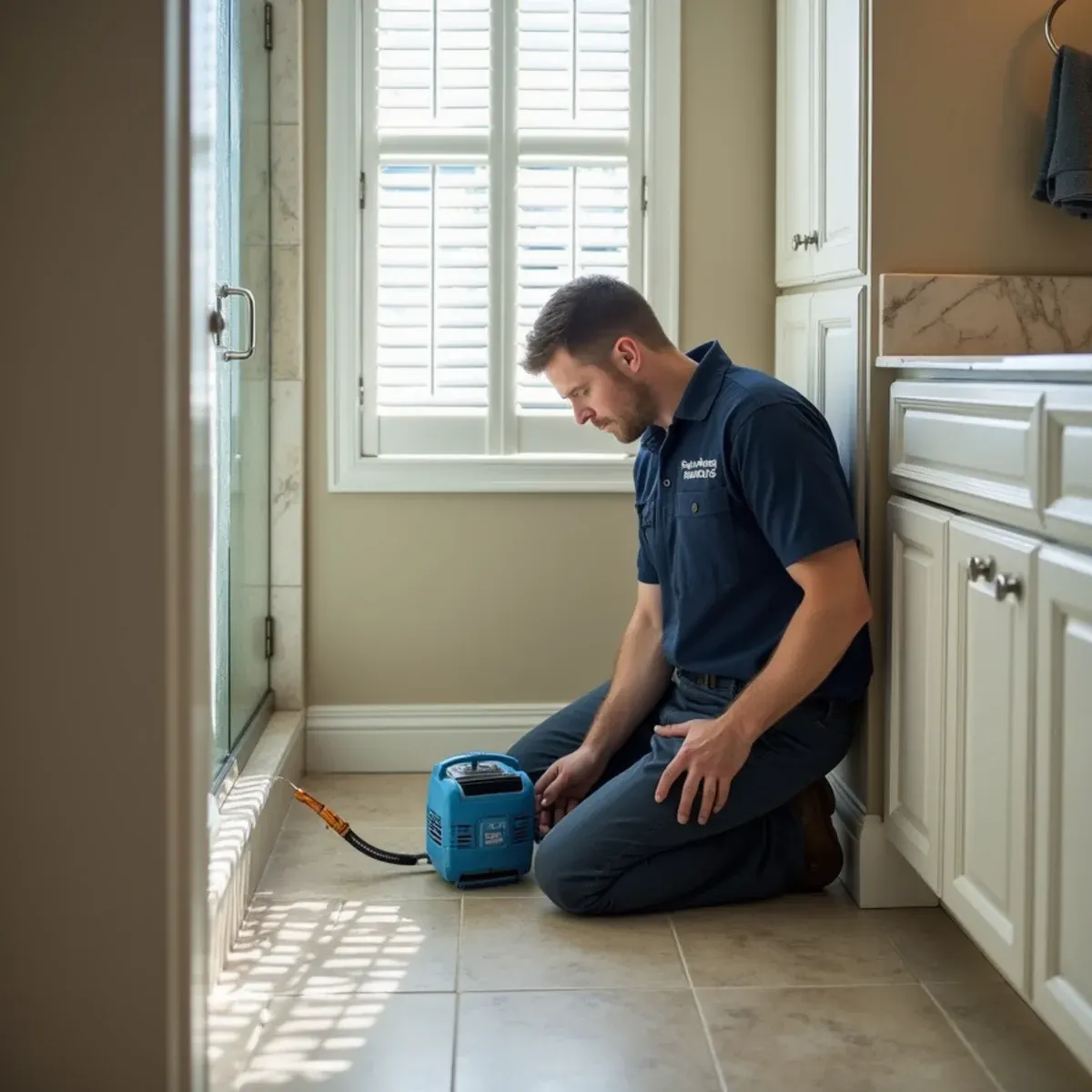
Straight answer on fit: Yorba Linda is newer than almost everywhere else we serve, mostly 1970 through 2005, and the deteriorated hot-mopped pan liners we pull out of 1950s houses are not the common story here. What is common is a second or third bathroom on an upper floor, sitting directly over a family room, entry or garage. When the pan-to-curb waterproofing cracks, the shower-door track leaks on the wrong side, or a toilet flange sits a hair low, the water has a ceiling to land on. Homeowners find the problem as a brown ring in the drywall downstairs, not as anything visible in the bathroom.
The rest of what makes Yorba Linda distinct is outside the house. This city was built into hills — engineered slopes, retaining walls, terrace drains and heavy irrigation on larger lots — and exterior water from failed slope drainage is the local signature failure. That matters for bathroom calls because it generates false leads. A downstairs wall goes damp, the upstairs bath gets blamed, and the actual source is a terrace drain backing up against a retaining wall on the uphill side. Parts of the city sit inside the 2008 Freeway Complex Fire footprint where burn-scar runoff behaved differently for years. We map before we cut.
What Yorba Linda Changes About Shower Pan Leaks
1Upstairs baths over living space
Two-story plans here put the master and secondary baths above rooms people actually use. A slow pan or flange leak wets the ceiling joist bay, spreads along the drywall seam, and shows up several feet from where it started. We map the ceiling from below and flood-test the pan above before opening anything, because the stain almost never sits directly under the failure.
2Newer pans fail at details, not age
In 1980s through 2000s Yorba Linda construction the pan material usually has life left, so we look at workmanship: waterproofing that stopped at the curb face, a bench built after the fact, a glass door retrofit that put screws through the pan flange. Those are fixable without gutting a bathroom, and knowing that up front keeps the scope honest.
3Slope drainage that mimics a bath leak
On these hillside lots, water from a plugged terrace drain or a failed retaining-wall weep can wet a lower-level wall in a way that reads exactly like a bathroom failure above. We check the uphill drainage and the exterior grade before we blame a shower. Getting that wrong means paying for a bathroom repair and watching the wall go damp again after the next storm.
How the Work Runs
The method is the same one we use on every shower pan leaks job, documented to the IICRC S500:2025 standard. Here it is in short — the full shower pan & bathroom leak repair process explains each stage in detail.
- Map the moisture first
- Flood test the pan
- Isolate the actual failure
- Open only what has to open
- Dry the structure to standard
- Rebuild the waterproofing correctly
The Yorba Linda Background Worth Knowing
A hillside lot in Yorba Linda is a drainage system with a house attached. Terrace drains cut across the face of the slope to intercept water before it gains speed. Brow ditches run along the top to keep runoff from ever reaching the slope face. Down-drains carry the collected water to the street or a storm connection. Retaining walls have weep holes and, behind them, a gravel subdrain that relieves pressure on the wall. Every one of those was engineered as part of the pad. Every one of them silts up, roots over, or gets buried by landscaping.
There is more on the housing stock, drainage and plumbing history of this city on our water damage restoration in Yorba Linda page.
Yorba Linda at a glance
- Dominant construction era
- 1970–2005
- Foundation type
- slab on grade
- Supply piping found here
- under-slab copper, later PEX and CPVC
- Drain line materials
- ABS, cast iron
- Terrain and water table
- hillside-mixed, deep water table
- Most common local failure
- exterior water from failed slope drainage, terrace drains and retaining-wall systems rather than from plumbing
- Highest-value local prevention
- clearing terrace and slope drains before the season, since a blocked one turns an engineered hillside into a funnel
What It Costs in Yorba Linda
We do not quote a number over the phone before seeing the property — anyone who does is guessing. The variables that actually move the price on a shower pan leaks job are how long the shower kept running, what sits under the shower floor, whether the framing is compromised, and they are broken down in full on the shower pan & bathroom leak repair page. The assessment and the written estimate are free anywhere in Yorba Linda, day or night, with no obligation.
Shower Pan Leaks Questions from Yorba Linda Homeowners
Maybe, but on homes this age the pan itself is usually sound and the leak is at a joint — the curb, the door track, the drain collar or a low toilet flange. We flood-test the pan with the drain sealed, run the shower separately with the door in normal use, and moisture-map the ceiling cavity from below. That sequence tells us whether water escapes when the pan holds standing water or only when someone showers, which points straight at the culprit.
Timing is the cleanest clue. A pan leak only produces water when the shower is running, so the symptom appears within hours of use and dries out between uses. A pressurized supply line leaks around the clock, and the damage grows steadily whether anyone is home or not. Shut off every fixture and watch the water meter's low-flow indicator. If it still moves, you have a supply leak, not a pan. We confirm it with a flood test either way.
Sometimes, and we will tell you honestly which case you are in. A leak at the drain clamping ring, or a failed seal where the surround meets the pan, can occasionally be handled with a limited opening. A split or perforated liner cannot. Liquid-applied products sold as pan sealers can buy a few months on a pinhole, but they will not repair a membrane that has failed at a fold or a corner, and we are not going to sell you that as a fix.
Seeping from the weep holes is usually the wall doing its job, relieving water pressure from the soil behind it. The concerning version is the opposite: weep holes that stay dry through a storm while the ground above stays soggy, which suggests the subdrain behind the wall is plugged and pressure is building. Also watch for new cracking, bulging, or a wall that has tipped slightly. Those are engineering questions rather than restoration ones, and we will say so.